
How to measure an ironing board
Measure the ironing surface for a replacement cover, then check the iron rest, open footprint, working height and folded size before buying a board.
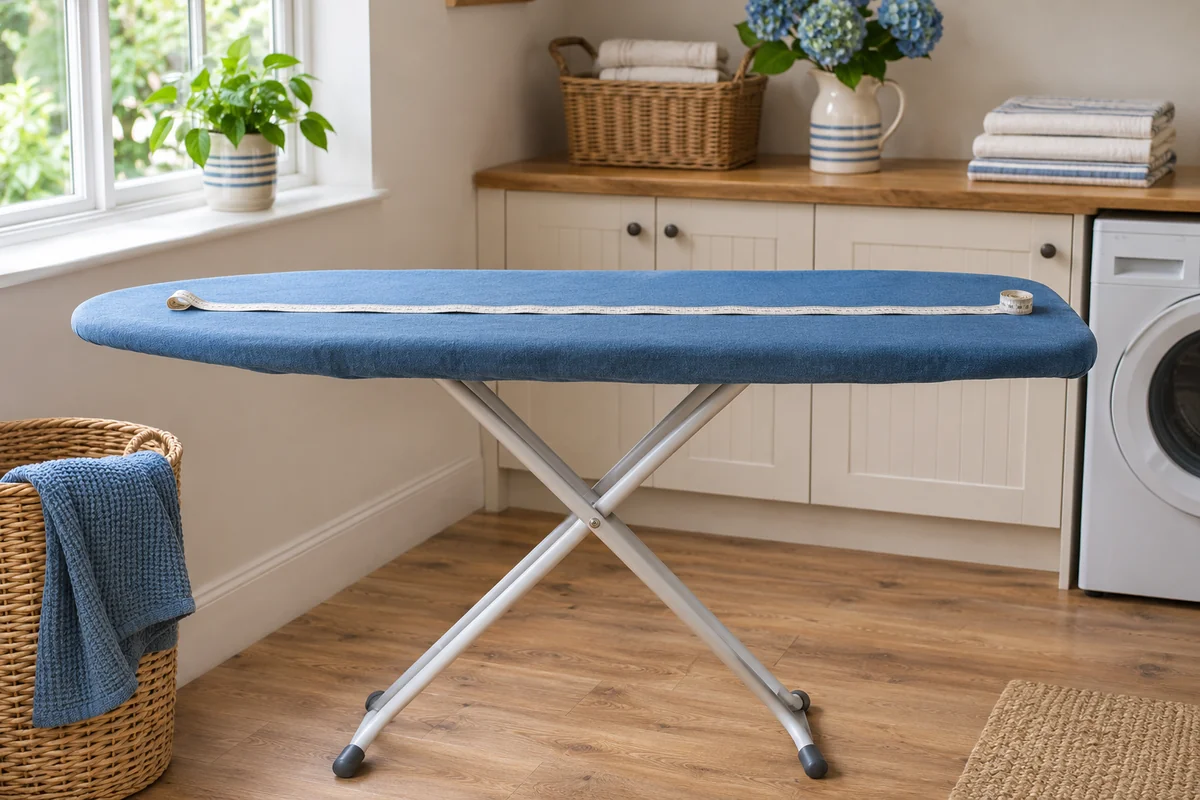
Before you get the tape measure out
Unplug the iron, let it cool and move it away. Open the board on a level floor, or use a stable worktop for a tabletop model. Engage the working lock if the board has one. A tape measure, a note on your phone and a photo of the board label are enough for the checks below.
Write what each figure describes. A number copied as “124 cm” might be the ironing surface, the overall length with the rest attached or a value taken from packaging. If you are working from a product listing, look for a drawing or a label against each measurement. The same board can have several legitimate sets of dimensions.
Step 1. Measure the pressing surface for a cover
- Find the actual edges. Locate the padded top that supports the garment. If a loose cover hides the edges, lift or remove it as the board instructions allow. Leave the separate rest, storage fitting and cover drawcord out.
- Measure the length in a straight line. Place the end of the tape at the furthest point of the nose. Run it along the middle of the top to the back edge. Keep it flat across the surface, without wrapping it down either end.
- Measure the widest part. Run the tape across the top at a right angle to the length. Shift it along the wider end if you are unsure where the maximum lies. Record that largest measurement in centimetres.
- Note the nose and fixing. Photograph the board from above. A broad rounded nose and a narrow tapered nose can have the same headline dimensions but need different fits. Look underneath for a cord, clips, tabs or another model-specific attachment.
Compare these measurements with the cover maker’s stated board fit. The piece of fabric itself needs enough material to wrap below the deck. If the listing only gives the cloth dimensions, ask which board size those figures fit. Check whether it is a top layer or a complete set with padding, then follow the installation instructions for your board.
Step 2. Match the size label and the shape
If you have the original cover, look at its label and the board’s model marking first. Brabantia lists S as 95 × 30 cm, A as 110 × 30 cm, B as 124 × 38 cm and C as 124 × 45 cm. That makes B and C the same length and seven centimetres apart in width. The letters describe Brabantia’s sizes, so use the centimetres and the shape when comparing another maker’s range.
The Brabantia Tabletop Board S 127663 is a useful example. Its pressing surface is 95 × 30 cm, while the maker lists overall dimensions of about 101.6 × 31 × 5.1 cm. Use the first pair for a replacement cover. The larger dimensions help when planning where the flat-folded board will go.
Brabantia Tabletop Board S 127663
A 95 × 30 cm deck and retractable hanging hook offer a conventional narrow pressing shape without a freestanding frame. The legs fold underneath.
Good for
A long narrow hanging space and regular shirts or blouse pressing.
Bear in mind
The deck does not fold in half. Allow roughly a metre of storage length and check the full unit dimensions, rather than treating the surface measurement as its total size.
- 95 × 30 cm
- Full unit about 101.6 × 31 × 5.1 cm
- Fold-out tabletop legs
- Cotton with foam layer
Once the cover is on, check the nose, long edges and back corners. The fabric should sit smoothly and stay in place when you move a garment across it. Fasteners should be clear of the hinge and legs. If it pulls away from the nose or forms a ridge through the pressing area after adjustment, check the fitting instructions and size before using it.
Step 3. Measure the space the board takes up while open
Open a freestanding board to the height you will use. Measure its overall length from the nose to the furthest edge of the rest or frame, and its widest point from above. Separately measure the span of the feet on the floor. The legs and top can project into different parts of a narrow room, especially near a skirting board, radiator or cupboard door.
Measure from the floor to the top of the pressing surface. Check how you stand with your elbow comfortably bent and your shoulder relaxed. Also leave room to move around the board, reposition a garment and reach the iron safely. In a narrow kitchen, use a tape measure or strips of paper to mark the likely outline and open the doors you will use while ironing.
For a tabletop model, measure the supporting surface and make sure all feet can sit securely on it as directed. Add the height of the deployed board to the height of the table. A board that raises the ironing surface by 11 cm puts it at 86 cm on a 75 cm table. That height may suit one person and feel awkward for another. Check it in your usual position before choosing where to set up.
Once you know the pressing surface, follow the cover fitting steps or check the exact Brabantia Board B options.
Step 4. Measure the rest separately, especially for a generator
An iron rest or generator holder needs its own measurements. For a steam generator, check the holder is intended for a station and measure the usable platform inside any rim. Compare the maximum base dimensions and any load limit with your appliance’s dimensions, filled weight and foot placement. Leave enough room for the hose to turn and reach across the board.
For example, the Brabantia Board B 219467 has a 124 × 38 cm pressing surface and a holder specified for steam units up to 40 × 22 cm. Those figures describe two different surfaces. A different Board B can have the same deck size with another rest. See the steam generator ironing board guide for exact support types and the checks that go with them.
Step 5. Measure the folded board and the route into storage
Close the board using its instructions, then secure its transport catch if fitted. Measure its longest point, its widest point and its thickest point. Include the iron rest, legs, handle and any hook in the position they will occupy in storage. For a door or wall hook, measure the space beneath and around the proposed fixing and follow the board maker’s mounting instructions.
Compare those dimensions with the clear cupboard opening as well as the internal space. Check hinges, shelf lips and the room available to turn the board on the way in. If the folded dimensions are close to the available space, try a cardboard template to see whether you can move it through the opening without forcing it.
The Joseph Joseph Pocket 50009 shows why folded depth matters. It has a 90 × 33 cm pressing surface, folds to 45.5 × 34 × 15.5 cm and raises its open surface 11 cm above the table. A short cupboard may suit that folded shape, provided the shelf has space for its depth and there is a suitable worktop for use.
Joseph Joseph Pocket 50009
The board folds across the middle, reducing its 90 cm surface to a 45.5 cm closed height. An integrated compartment keeps a cooled iron with the board.
Good for
A cupboard that cannot take a metre-long board, with a suitable worktop available.
Bear in mind
The folded unit is 15.5 cm deep. The storage compartment and folding shell take more cupboard depth than a flat board.
- 90 × 33 cm
- 45.5 × 34 × 15.5 cm
- Surface 11 cm above tabletop
- Cotton with padded underlay
If you are still deciding between a folding board and a long, flat-storing board, compare those two storage shapes in the tabletop ironing board guide.
Keep one note with all the measurements
Save this list with a photo of the board and its model number. It gives you the figures you need for a cover, a replacement board or a different place to store it.
- Pressing surface: length ___ cm × widest width ___ cm, with nose shape and attachment type.
- Open board: overall length ___ cm × widest point ___ cm, with the foot span recorded separately.
- Working height: floor to pressing surface ___ cm, or tabletop height plus board rise.
- Iron or generator support: clear platform ___ cm × ___ cm, with the maker’s permitted appliance and load limits.
- Folded board: longest point ___ cm × widest point ___ cm × thickest point ___ cm.
- Storage route: clear opening ___ cm × ___ cm, with hinges, handles and turning space checked.
Before buying, try the reach and clearance you will need. The ironing board height guide covers working while standing or seated.
Manufacturer sizing and fitting references
Frequently asked questions
Do I include the iron rest when measuring an ironing board for a cover?
Leave the separate iron rest out. The cover goes over the pressing surface, from the tip of the nose to the back edge. Include the rest when measuring the whole board for storage or use.
Where do I measure the width of an ironing board?
Find the widest part of the pressing surface and measure straight across at a right angle to its length. This is often towards the square end. If the board curves there, compare two or three points to find the widest one.
Can I measure my old ironing board cover instead?
Use its size label or part number if legible, then check it against the board. Measuring the loose cover itself can give a misleading result because its fabric wraps underneath and may have stretched or shrunk.
Will a universal cover fit a tabletop ironing board?
Check the stated fit range, nose shape and attachment method. A folding tabletop board may use a model-specific cover to fit its deck and folding mechanism. Check the board maker’s replacement options if the current cover attaches in a particular way.
What size cover fits a 124 × 38 cm ironing board?
Brabantia lists 124 × 38 cm as Board B. For another brand, choose a cover whose stated fit range includes that pressing surface and whose nose shape and fastening suit the board. Board letters are specific to the maker.
How do I measure a board for a narrow cupboard?
Fold the board, secure its transport catch if fitted and measure its longest, widest and deepest points. Compare all three with the opening between the door and frame, the space inside and the room to turn it into position.