
Best sleeve boards for home ironing
Compare three small pressing boards by usable width, tip shape and cover. Learn how to press and rotate a sleeve without flattening both layers.
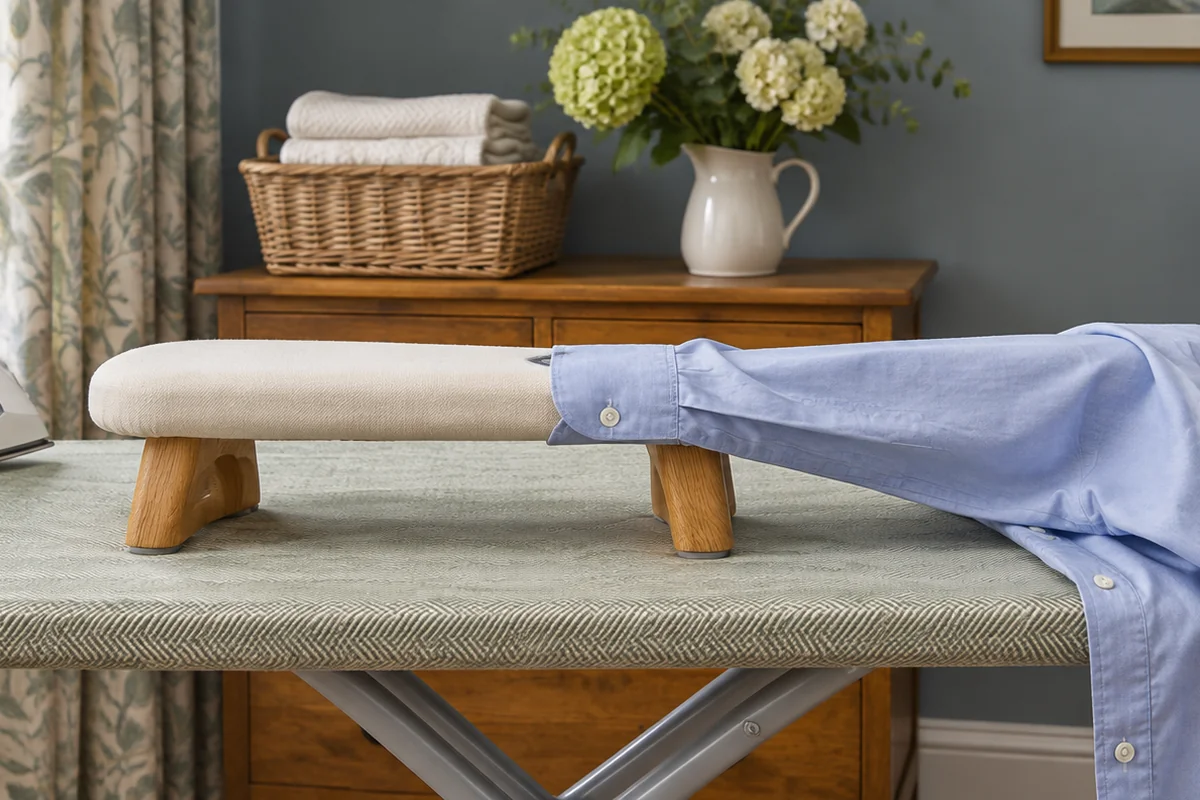
Choose by fit
Choose Brabantia for a longer narrow deck, Leifheit for a tapered oval end or Prym for wider support and a sewing scale. Match the deck to the cuff opening before ordering.
Brabantia Sleeve Board
102400
Longer sleeves that can slide over a 10 cm deck.
View on AmazonLeifheit Sleeve Ironing Board
71820
Shirt or blouse sleeves that benefit from a narrower starting point.
View on AmazonPrym Sleeve Ironing Board
611912
Wider sleeves, open seams and sewing tasks that benefit from a marked surface.
View on AmazonSpecifications at a glance
Scroll sideways to compare all models.
| Specification | Brabantia Sleeve Board 102400 | Leifheit Sleeve Ironing Board 71820 | Prym Sleeve Ironing Board 611912 |
|---|---|---|---|
| Pressing surface | 60 × 10 cm | 57 × 8.5–10.5 cm | 52 × 12.5 cm |
| Shape | Long, narrow deck | Oval end, variable width | Shorter, wider deck |
| Cover | Cotton with foam layer | Fitted sleeve-board cover | Reversible with a centimetre scale |
| Storage | Folding support | Folds flat | Check the folded profile |
Manufacturer figures. Check the exact model and the dimensions of the full setup before buying.
Choose a board the sleeve can slide over
A sleeve board is a small raised pressing surface. Slide an open cuff over the narrow end and work on one layer at a time. That leaves you free to rotate the sleeve and smooth the next panel without pressing an unwanted crease into the layer underneath. It can also help with short trouser legs, sewing seams and small details that are awkward on a full-width board.
Measure the narrowest part of the opening you need to feed over the board. An opening can fit over the tip but catch farther along as the deck widens. Look at the taper and the space beneath the board as well as the stated width. Leave enough room to turn the fabric without snagging a placket or pulling against the support.
Brabantia 102400 for a longer, narrow pressing surface
Brabantia gives the ecru 102400 a 60 × 10 cm pressing surface. The maker lists a cotton cover with a foam layer, protective non-slip caps and a folding frame. The length can support more of a long shirt sleeve where the opening fits the 10 cm board.
Brabantia Sleeve Board 102400
A 60 × 10 cm sleeve board with a cotton cover, foam layer and folding support.
Good for
Longer sleeves that can slide over a 10 cm deck.
Bear in mind
Check your cuff opening and the full support footprint on the work surface.
- 60 × 10 cm
- Folds away
If you regularly iron long sleeves, check how far you can slide each one over the nose before it bunches. A 60 cm surface gives you room to advance in sections, and the back end can support a wider upper arm. Use a flat, stable surface suitable for pressing and set the iron on its approved rest between passes.
Leifheit 71820 for a narrower, rounded end
The Leifheit pressing surface is 57 cm long and varies from 8.5 to 10.5 cm in width. The rounded end is useful if the opening needs a smaller entry point. A simple folding mechanism lets you store the board flat when you finish.
Leifheit Sleeve Ironing Board 71820
A 57 cm pressing deck with an oval end and a width that varies from 8.5 to 10.5 cm.
Good for
Shirt or blouse sleeves that benefit from a narrower starting point.
Bear in mind
The cuff may fit at the tip and stop farther up the board as it widens.
- 57 cm length
- 8.5–10.5 cm width
The width changes along the deck, so test the shape against the cuff and placket before you buy. A tight cuff can limit how much of the board you can use at once. If the fabric slides only a short way without strain, press that section, lift the iron, and move the sleeve along a little at a time.
Prym 611912 for wider openings and sewing seams
Prym lists this board at 52 × 12.5 cm. The reversible cover has a centimetre scale on one side and a heat-reflecting face on the other. The short, wider deck is useful for laying out an open seam, or for sleeves and trouser legs wide enough to fit over the end.
Prym Sleeve Ironing Board 611912
A 52 × 12.5 cm board with a reversible cover that has a metric scale and a heat-reflecting face.
Good for
Wider sleeves, open seams and sewing tasks that benefit from a marked surface.
Bear in mind
Check narrower cuff openings against the 12.5 cm board before choosing it.
- 52 × 12.5 cm
- Reversible cover
Check the fit if you usually iron narrow cuffs. A wider board can give fabric more support once it is on the deck, but it may require you to work on the outside of the garment when the opening is too small. Set the cover up as Prym instructs and follow the garment’s care label for temperature and steam.
Check what the dimensions mean for your garments
Take a sleeve from a shirt you iron often, unfasten the cuff and lay the opening flat without stretching it. Measure across it and look at how the fabric tapers towards the cuff. Use that as a first check against the board's profile. Seam bulk, stiff interfacing and a short placket can all restrict how far the fabric can slide. Avoid forcing a tight opening over a wide end, particularly on a delicate blouse.
Check where the board will sit with the support fully open. Its feet should be flat and the mechanism should be secure before the iron heats. Choose a supporting surface that the board maker allows, and check it can tolerate the heat and steam you will use. The board’s own height adds to the working height beneath it. If that puts the iron too high or too far away, use a different approved surface. The ironing board height guide explains the reach check.
Check the folded profile for storage and look up the replacement cover by model. A worn cover or thin patch can leave the shape of the deck showing through the fabric. Fit a cover approved for the board, pull it smooth and check it stays put while you rotate the garment. Leave the board open to cool and dry as directed before putting it away.
Press and rotate a sleeve in short sections
- Read the garment label and prepare the iron. Unfasten the cuff and set the permitted heat and steam. Start on an inconspicuous area if you are unsure how the fabric finish will respond.
- Open the cuff and ease the sleeve on. Guide it over the end without stretching the opening. Smooth the upper layer with your hand while the iron is safely on its rest.
- Press the visible panel. Work in short passes so you can see where the soleplate will go. Keep clear of buttons, trim and folds you want to preserve.
- Lift the iron before rotating. Park it as the maker directs, turn the sleeve to expose the next section, then smooth the fabric again. If you are working on a shaped seam, realign it before pressing.
- Let the fabric settle. Check the sleeve in good light. Move it aside before the next garment so the freshly pressed fabric can cool without being crushed.
For the rest of the shirt, follow the order in how to iron a cotton shirt. If you want a visible crease down the sleeve, align the layers on a full board and press the crease where the garment’s finish permits it. If your usual laundry mainly consists of wider pieces, the nose of a tabletop board may give you enough room for occasional sleeves.
Manufacturer specifications
Frequently asked questions
Do you need a sleeve board to iron shirts?
A sleeve board lets you press one layer and rotate the sleeve. You can use the nose or main surface of a full board if it supports the section you want and suits the finish you prefer.
What width sleeve board do I need?
Measure an open cuff and look at how the sleeve tapers. Check the tip and the wider parts of the board. Choose a shape the opening can slide over without stretching.
Can I put a sleeve board on my ironing board?
Use the support the sleeve-board maker permits. The base needs firm, level support for all feet, and the main board must be stable and wide enough for the setup. Check height and reach before heating the iron.
How do you iron a sleeve without making a crease?
Use the heat allowed by the garment label. Slide the open sleeve over a suitable narrow board, press the upper layer, park the iron and rotate the fabric to reach the next area.
Can you use a sleeve board for trouser legs?
It can support trouser legs that fit over the end. For a deliberate long crease, the full board usually gives more room to align both layers and keep the line straight.
Can I use steam on a sleeve board?
Check the garment label, the board cover and the surface below. Some covers are designed to let vapour through, so the support still needs to tolerate the steam you plan to use.